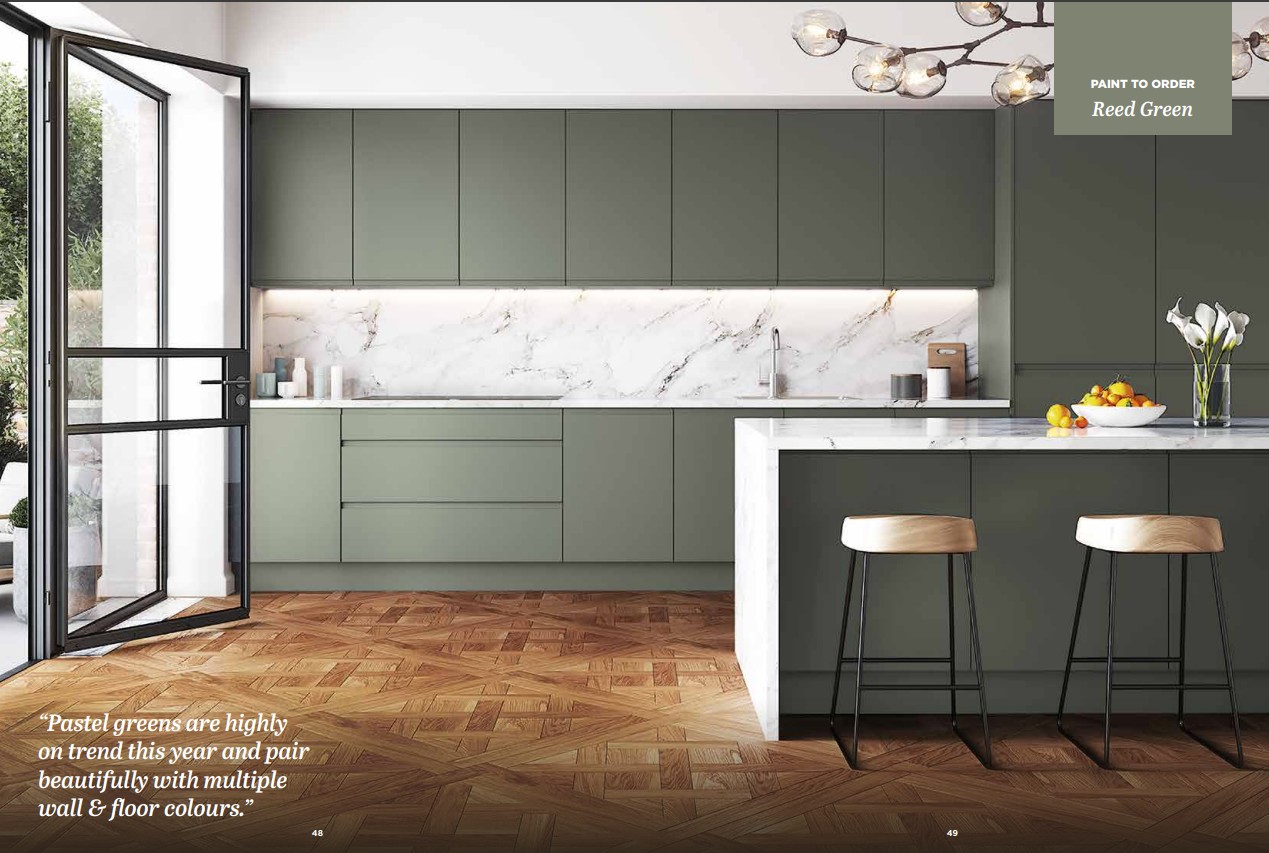
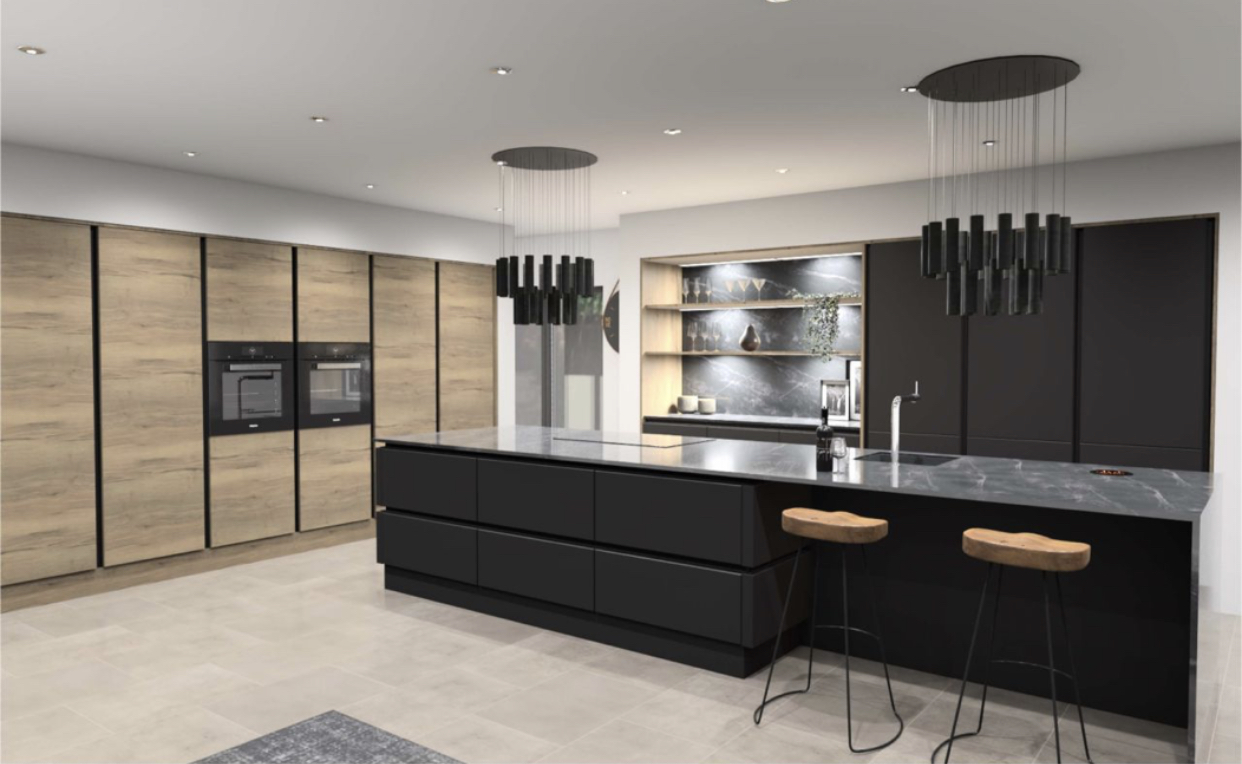
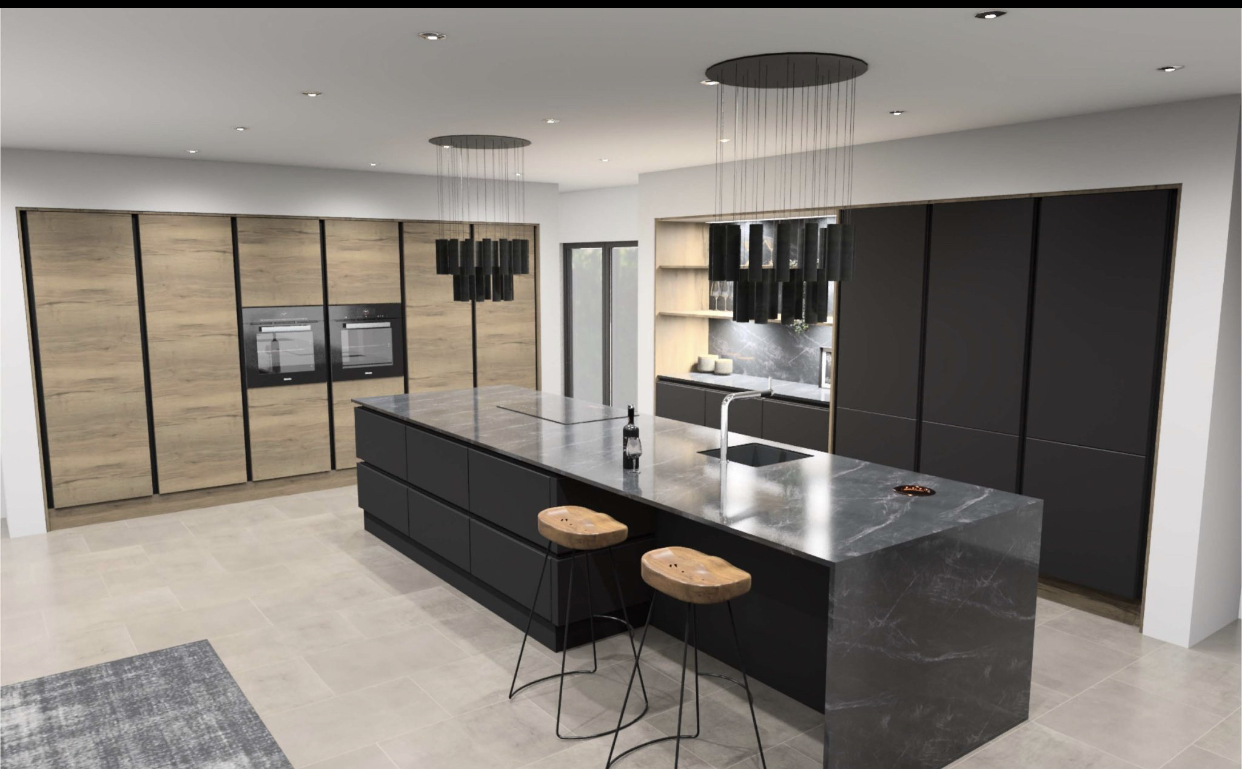
A waterfall island is the single most dramatic thing you can do with stone in a kitchen — the worktop material continues in an unbroken sheet down the vertical end panel to the floor, with the mineral veining flowing seamlessly around the mitred corner.
Tell us your preferred material and island dimensions — we'll show you book-matching options and quote within 24 hours.
On a standard island, the worktop stops at the edge and a separate panel (often a painted or veneered end panel) covers the side. A waterfall edge instead wraps the same slab of stone over the edge and down the vertical face to the floor, joined with a precision-cut 45° mitre.
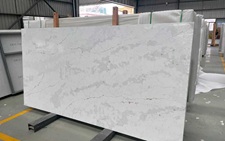
Done well, the veining pattern appears to flow continuously around the corner — as though the entire island were carved from a single block of stone, rather than assembled from separate pieces. This is achieved through book-matching: cutting the horizontal and vertical panels from adjacent sections of the same slab so the grain lines up precisely across the mitred joint.
| Feature | Waterfall Edge | Standard End Panel |
|---|---|---|
| Visual Impact | Showstopper | Understated |
| Material Continuity | Book-Matched Stone | Painted / Veneered Panel |
| Durability of Edge | Stone-Hard, Scuff Resistant | Can Chip or Mark |
| Relative Cost | Higher (Extra Slab Area) | Lower |
Not every worktop material is suited to a waterfall edge — it demands consistent slab thickness, a stable mitre joint, and (ideally) a bold or flowing pattern that rewards the continuous drop. These are our top picks, all covered in depth on our kitchen worktops pages.
The most popular waterfall material by far — consistent colour and veining from slab to slab, so the mitre join is easy to match precisely. Explore our full range on the quartz worktops page.
Ultra-thin 12–20mm panels create a crisp, architectural mitre line and are available in dramatic large-format designs. See heat and scratch performance on the ceramic & porcelain worktops page.
Unmatched for dramatic, one-of-a-kind veining, though softer and more porous than engineered alternatives — best suited to lower-traffic statement islands rather than the primary prep surface.
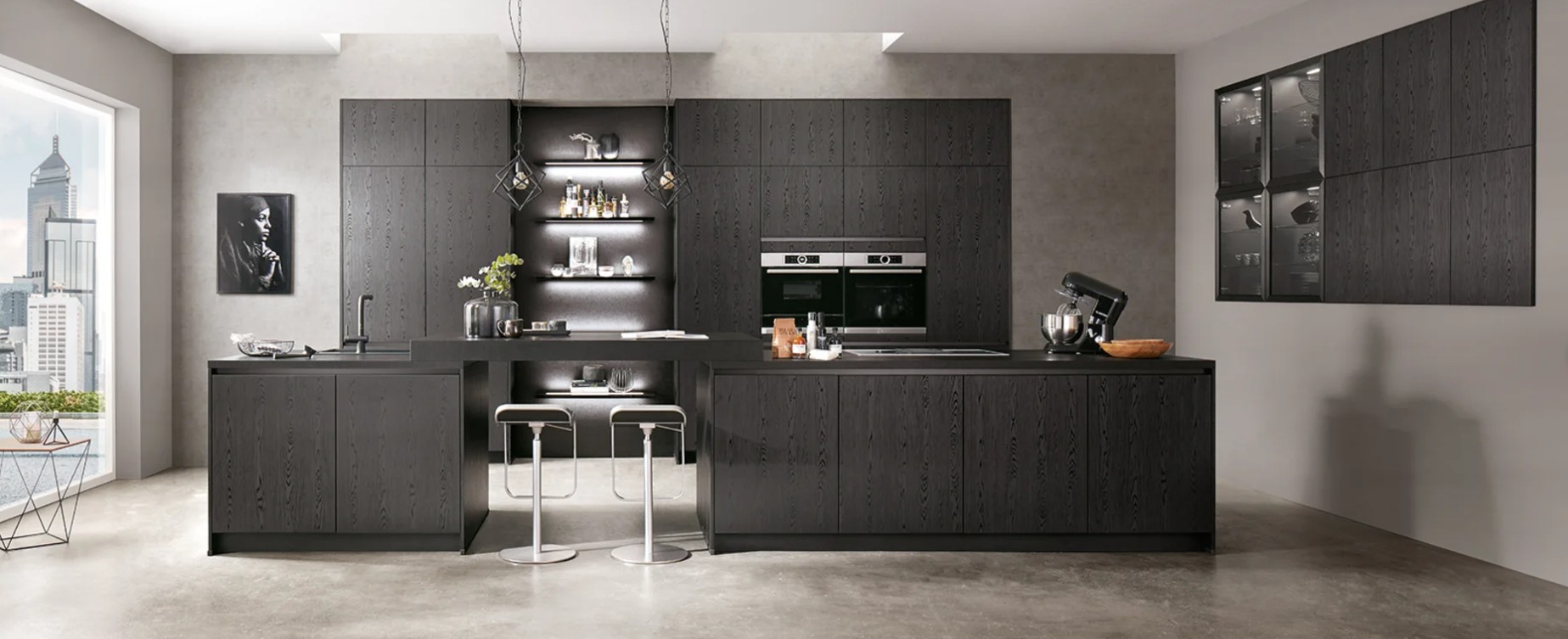
Where the room allows, an oversized island — often 3m or more in length — becomes the architectural centrepiece of the whole ground floor, not just the kitchen. Jumbo slab formats (up to 3,200 x 1,600mm) mean fewer joints across large islands, keeping the waterfall drama uninterrupted.
A waterfall island doesn't need to match the perimeter worktop. Increasingly popular is a bold, dark, or richly veined island set against lighter, more neutral perimeter cabinetry — or the reverse, a pale statement island framed by a darker perimeter run for drama and depth.
Good lighting is what turns a waterfall island from a nice feature into the focal point of the room after dark.
Two or three pendants hung 700–800mm above the worktop draw the eye down the island's length and cast warm pools of light across the stone's veining.
A discreet LED strip beneath the island's base makes the whole unit appear to float, and throws a soft glow across the floor — especially striking against a dark waterfall end panel.
A low-angle light source grazing across the waterfall panel accentuates the texture and depth of the stone's veining, making the mitre join virtually disappear.
A curated selection of dramatic, large-scale, and premium-finish islands from recent London projects.
What homeowners typically ask before committing to a waterfall island.
Visit our showroom to see book-matched slab pairs in person, or book a free design consultation to explore materials for your space.










 GET QUOTE