

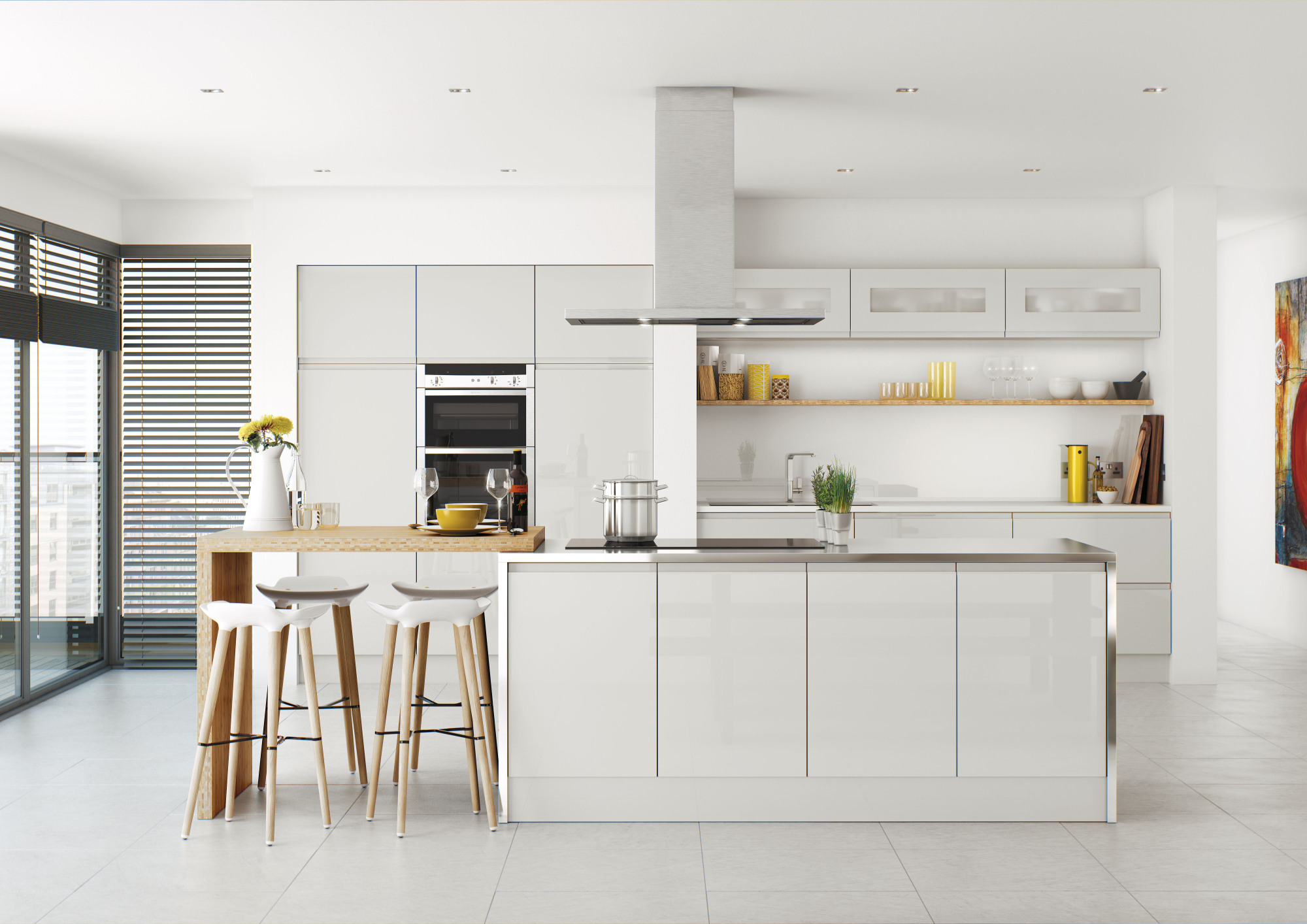
A continuous 22mm deep ergonomic J-groove routed directly into the top edge of each door for secure finger grip.
Unlike rail systems, J-profile doors require no carcass cutouts, preserving 100% of internal cabinet volume.
Multi-coat factory-lacquered returns seal the routed scoop completely against steam, cooking heat, and moisture.
Provides the clean, flush lines of handleless design without the added structural complexity of recessed rail carcasses.
For homeowners who desire the sleek, uninterrupted sightlines of a modern handleless kitchen without compromising everyday practicality, J-profile (commonly known as J-pull) cabinetry represents the ideal design balance. By integrating an ergonomic curved channel directly into the edge of each door and drawer frontal, J-profile kitchens eliminate projecting hardware while ensuring intuitive, tactile accessibility.
The grip channel is cut into the 22mm door front itself. Cabinets use standard carcasses, maximizing internal drawer depth and making installation straightforward while remaining cost-effective.
Doors are completely flat slabs, and the grip space is created by an anodised aluminium rail built into the cabinet carcass. Delivers an ultra-minimal look, but requires specialized carcasses and slightly reduces top-drawer height.
Low-grade J-pull doors are often made with thin 18mm boards and vinyl foil wrapping, which can peel along the sharp curvature of the handle scoop. At Xeeni, our J-profile frontals are manufactured to strict architectural specifications:
Machined from high-density moisture-resistant composite (HDF/MR-MDF) to provide a deeper, more comfortable fingertip channel that won't flex under heavy loads.
Sprayed with five coats of polyurethane paint, completely enveloping the J-scoop with no seams, foil joints, or edge-banding glue lines where dirt or steam can penetrate.
Fitted with German-engineered hinges and drawer runners calibrated to cushion closing momentum quietly, protecting painted door lips over decades of use.
| Finish Category | Visual Personality | Best Suited Architectural Environment |
|---|---|---|
| High-Gloss Pure White & Alabaster | Reflective, luminous, expansive | North-facing rooms, compact London apartments, and modern galley spaces |
| Super-Matt Cashmere & Dust Grey | Soft, tactile, contemporary neutral | Sun-drenched open-plan extensions and understated modern conversions |
| Deep Anthracite & Graphite | Moody, dramatic, architectural contrast | Industrial warehouse lofts and spacious island-centred footprints |
| Painted Heritage Tones (Sage & Navy) | Warm transitional balance | Period properties undergoing sleek, modern ground-floor extensions |
Technical guidance on worktop overhangs, edge sealing, tall cabinet routing, and finish repairs.
Unlike standard handled kitchens where worktops typically overhang doors by 20mm to 30mm, J-profile kitchens require a minimal flush or semi-flush overhang (usually 5mm to 10mm). This ensures unobstructed fingertip access to the routed top channel while protecting the door face from accidental liquid spills from above.
Vinyl-wrapped doors use heat-stretched PVC film bonded over MDF with adhesive. The tight curve of the J-groove is under continuous mechanical tension, meaning heat and steam from boiling kettles or dishwashers often cause the vinyl to lift or bubble over time. Xeeni's painted J-profile doors feature spray-cured polyurethane lacquer that penetrates the substrate, creating a monolithic seal with zero edge seams that can never peel.
On full-height tall units, routing a channel across the top is impractical due to ceiling height. Instead, the J-groove is precision-milled vertically down the entire leading vertical edge of the door. This enables comfortable opening from top to bottom, accommodating adults and children alike.
Yes. Because our doors are finished with high-durability painted polyurethane lacquer rather than plastic laminate or foil wraps, minor surface chips on the scoop edge can be easily touched up using color-matched touch-up kits supplied with your kitchen, or professionally re-sprayed without replacing the entire door.
Yes. Many designers prefer using J-profile doors for high-use base and pan drawers (where physical pull leverage is essential) and pairing them with completely flat, handleless push-to-open wall units above. This creates a clean, architectural transition across eye-level cabinetry.










 GET QUOTE